By D. Allan Kerr
You can’t blame an old-school Navy town like my adopted home of Kittery, Maine, for hyping any connection to the legendary Father of the American Navy, John Paul Jones.
Even before it was home to Portsmouth Naval Shipyard, Maine’s oldest town was the construction site for the Ranger, the warship which brought the Scottish-born badass his initial fame and glory.
But the first American naval hero of the Revolutionary War, it turns out, was actually a Kittery native. And I frankly have no idea why Jeremiah O’Brien isn’t a household name today, not only in Maine classrooms but all across the country.

Among many other accomplishments in a storied career, O’Brien became the first colonist to claim a British flag during the Revolution when he led a daring assault resulting in the capture of a crown warship, HMS Margaretta.
The United States Navy has named no less than five ships after O’Brien over the past couple of centuries, including the World War II destroyer USS O’Brien (DD 415), which was sunk by the Japanese in 1942.
Additionally, the World War II liberty ship SS Jeremiah O’Brien, manned by members of the U.S. Merchant Marine to carry wartime cargo, still operates in San Francisco as a living museum.
A Maine state park in Machias was dedicated in honor of O’Brien and every June the town commemorates one of America’s first naval victories of the Revolutionary War with its annual Margaretta Days Festival.
The event is named after the British ship taken during the battle – described by famed 19th-century novelist James Fenimore Cooper as “the Lexington of the sea” – by townsmen wielding pitchforks and axes.
This engagement also is considered the birth of the Merchant Marine. And yet, it’s a pretty safe bet most Americans outside of Maine (and a disappointing number of current residents) are not familiar with the exploits of this colorful character.
I have to admit, I only learned of O’Brien’s heroism from Raymond Faulkner, a Coast Guard veteran and history buff in Portsmouth, New Hampshire.
Jeremiah was the oldest of six brothers, all born to Irish immigrant Morris O’Brien and his Kittery-born wife Mary, who gave birth to Jeremiah in Kittery around 1740.
According to Rev. Andrew M Sherman’s 1902 biography, “Life of Captain Jeremiah O’Brien,” the clan later relocated to Scarborough before settling in Machias around 1766 to establish a lumber mill. It was in this Down East seaport where the battling O’Brien brothers, led by Jeremiah, established a level of notoriety.
After digging just a little into their escapades, my burning question is: Why isn’t this story already an HBO miniseries?
Maine genealogist/historian and Machias resident Valdine Atwood said Jeremiah was a “bigger-than-life individual.”
“He was a hot-headed Irishman,” she said. “He was a smart fellow but he was quite a character.”
To give an example, Atwood said Sherman, the Methodist minister who wrote the definitive biography of O’Brien, was the son of O’Brien’s illegitimate daughter, a fact the reverend never mentioned in his nearly 340-page volume.
Although no documentation has turned up, Atwood said genealogists believe Morris and Mary O’Brien were married in Kittery. Morris is said to have been born in Dublin, Ireland, while Mary and their three oldest children – Jeremiah and his sisters Martha and Joanna – were all born in Maine’s oldest town. Over the years, the family was joined by brothers Gideon, John, William, Dennis and Joseph, as well as another sister, Mary.
Jeremiah, it seems, was a born leader, according to his grandson Sherman’s glowing descriptions:
He could swing a woodman’s axe; raft the prostrate timber through the river to the mills; transform the rough logs into marketable lumber; throw a contestant in a friendly wrestling match, or drive a shrewd bargain for the disposition of lumber with the master of a coasting vessel, with equal ease; and yet Jeremiah O’Brien was neither bully nor brawler nor miser, but a young man of ‘excellent character.’
But Atwood says the town clerk of Machias, Jonathan Longfellow, once brought Jeremiah to court for throwing him to the ground and “beating him up.”
Physically, Jeremiah was “well-proportioned, and weighed about one hundred and seventy-five pounds when in good flesh. In physical strength he was an athlete, both inheritance and his own mode of life having contributed to this effect; and he was not, by any means, lacking in agility,” Sherman wrote.
So his fighting spirit apparently made Jeremiah the right man in the right place when the events culminating in the Battle of Machias – also known as the Battle of the Margaretta – transpired in June 1775.
***
The most popular account associated with the incident starts with a liberty pole erected in the middle of Machias following the bloody Revolutionary War events of Lexington and Concord, Massachusetts, in April 1775.
Liberty poles were installed throughout the Colonies around this time to represent support for the patriotic cause against British tyranny. Located more than 250 miles from Maine’s southern border, Machias is even today a four-hour drive away, but talk of the skirmishes in what are now Boston suburbs eventually reached the small frontier town and its residents wanted to display their patriotism.
In early June, the British warship HMS Margaretta accompanied two merchant vessels carrying much-needed provisions to the northern seaport, with the goal of returning to Boston with timber required to build barracks for the King’s troops there.
As the story goes, the British skipper, a young midshipman named James Moore, ordered the Machias liberty pole to be taken down.
According to Sherman, one of O’Brien’s brothers, John, retorted: “Those words are very easily spoken. You will find, I apprehend, that it is easier to make than it will be to enforce a demand of this kind.”
The Royal Navy officer reportedly replied that the pole must be taken down “or it will be my painful duty to fire upon the town.”
The good people of Machias held more than one town meeting to decide the matter and, according to lore, the O’Brien brothers were fired up for the patriot cause. Ultimately, the townsfolk decided not only to leave the pole intact but to seize the British skipper Moore, the local merchant acting on the crown’s behalf and the Margaretta herself.
Moore managed to escape to his ship and head downriver. Yet one O’Brien’s youngest brothers, Dennis, and some friends seized the Unity, one of the merchant ships from Boston.
Jeremiah was among nearly three dozen men – including all the O’Brien boys – who then set out in pursuit of the British warship on June 12. Legend has it old Morris, the 60-year-old O’Brien clan patriarch, had to be dissuaded from joining them.
The colonists wielded axes and pitchforks, along with some muskets, in their effort to capture this vessel of the world’s mightiest Navy. Jeremiah was unanimously chosen from the ranks to serve as captain. He then permitted some of the more fainthearted townsmen to row to shore in a small boat before engaging with the enemy.
“Now, my brave fellows, having got rid of those white-livered cowards, our first business will be to get alongside of the schooner yonder,” Jeremiah reportedly roared, “and the first man who boards her shall be entitled to the palm of honor.”
That man turned out to be his feisty brother John, who found himself on the deck of the Margaretta when the ships closed quarters and all alone against the British crew when the vessels suddenly broke apart. He promptly jumped overboard to avoid enemy bayonets and had to be fished out by his fellow patriots.
Eventually the two ships came close enough for Jeremiah to have his crew lash the vessels together and then lead a boarding party brandishing pitchforks and other weapons.
The unfortunate young officer Moore was killed by gunfire during the exchange, prompting the British surrender. According to Sherman, it was Jeremiah who hauled down the ensign of the enemy ship, bringing him the honor of taking the war’s first British flag.
“That the Americans had so quickly brought their more powerful foe to terms, spoke volumes for their pluck and determination … Nor were they content to rest with the capture of the schooner,” historian Willis J. Abbott wrote in his 1890 book, “Naval History of the United States.”
Not surprisingly, Cooper – celebrated author of such adventure classics as “The Last of the Mohicans” and “The Deerslayer” – was a bit more lyrical in describing the events in his own 1839 volume of Navy history.
“This affair was the Lexington of the sea,” Cooper wrote, “for like that celebrated land conflict, it was a rising of the people against a regular force, was characterized by a long chase, a bloody struggle, and a triumph.”
***
Recounting all of O’Brien’s wartime escapades would require a heck of a lot more words. But they really do require big-screen treatment.
The very next month after O’Brien’s victory over the Margaretta, the British sent two more warships – the Diligent and the Tapnaquish – from Nova Scotia after the irascible Irish-American.
The guns of the Margaretta had been transferred to the Unity, which became the Machias Liberty, and on July 12 he and fellow Machias captain Benjamin Foster instead captured both of these vessels.
“The exploits of Capt. O’Brien stirred up seamen from Maine to the Carolinas, and luckless indeed was the British vessel that fell into their clutches,” naval historian Abbott wrote.
To show its appreciation, the Massachusetts Legislature appointed O’Brien a captain of the Colony’s Marine and dispatched him to pursue vessels supplying the British. The naval hero also dined with Gen. George Washington around this time, Sherman wrote.
O’Brien sailed on as a privateer, a sort of legalized pirate authorized to capture enemy merchant ships. He was taken prisoner off the coast of New York while serving as skipper of the Hannibal sometime around 1780 and promptly confined under horrible conditions within the prison ship Jersey docked in the harbor.
After six months of confinement, O’Brien was shipped to England and locked up in the infamous Mills Prison. After many months, he secretly arranged for a change of clothes and a rowboat. He shaved off his ragged beard, switched clothes and strolled coolly off the prison grounds at night to the boat, which carried him across the English Channel to France. From there he eventually made his way back to Maine.
Toward the end of the war, he was appointed colonel of the Machias militia and referred to as Colonel O’Brien for the remainder of his life. He later was appointed Collector of Customs for the District of Maine, which was then still part of the colony of Massachusetts.
While Jeremiah never had children with his wife Elizabeth, he fathered a daughter named Lydia in 1804, when he was about 64 years old. The girl’s mother was Thankful Whitney, a a household servant of about 24.
Jeremiah and his wife raised the girl in their home until he passed away in September 1818. Lydia later gave birth to Sherman, her father’s biographer, Atwood said.
In Machias and maritime circles, O’Brien’s legacy lives on. The Margaretta Days Festival, which this year is scheduled to take place at the University of Maine’s Machias campus from June 16 to 18, will include battle reenactments, period music and food, a craft fair and a Liberty Ball.
The event also will also feature the New Hampshire/Maine Seacoast region’s celebrated Piscataqua Rangers Junior Fife & Drum Corps.
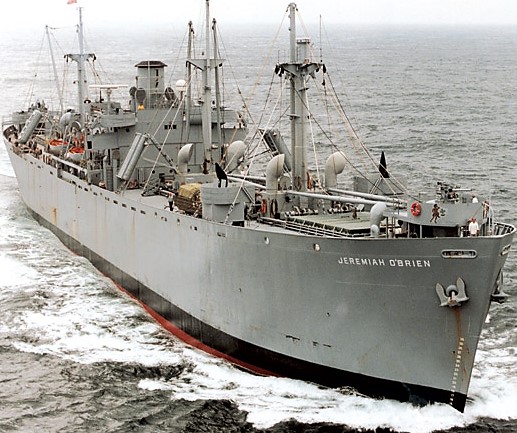
Faulkner, the Portsmouth history buff, said he first became interested in O’Brien decades earlier when he read the World War II liberty ship named in the rebel leader’s honor, was returning to Maine after participating in a 50th anniversary commemoration of the Normandy Invasion.
The SS Jeremiah O’Brien, built in South Portland, Maine, made 11 English Channel crossings with personnel and supplies as part of the June 1944 D-Day invasion. Today, the ship is berthed at San Francisco’s famed Fisherman’s Wharf for visitor cruises.
The USS O’Brien (DD 415) and other Navy destroyers bearing the name honor all six O’Brien brothers. DD 415 reportedly steamed almost 3,000 nautical miles before sinking, with no lives lost, after being struck by a Japanese torpedo during World War II. The most recent USS O’Brien (DD 975) was decommissioned in 2004.
In recent years, another Kittery-born Revolutionary War figure – Gen. William Whipple, a Declaration of Independence signatory – gained renewed appreciation. A reenactor portraying the good general returns annually to Kittery around Independence Day for a public reading of the Declaration.
Jeremiah O’Brien is due some fresh interest, as well.
D. Allan Kerr is the author of Silent Strength: Remembering the Men of Genius and Adventure Lost in the World’s Worst Submarine Disaster.
Follow D. Allan Kerr on Sloth Blog, Facebook and seacoastonline.com


Leave a Reply